
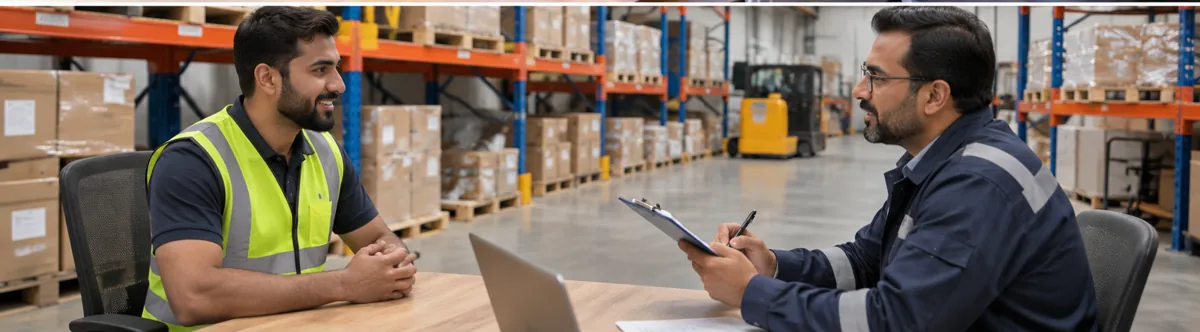
Warehouse Job Interview Questions in UAE: Answers and Checklist (2026)
Preparing for warehouse job interview questions in UAE can help you explain your skills clearly, whether you are applying as a warehouse assistant, picker, packer, inventory helper or storekeeper. Employers often want to understand how you follow instructions, protect stock, work safely and handle a busy shift.
This article provides realistic practice questions and example answers. It does not promise an interview or list live vacancies. Adapt every sample to your actual experience and the responsibilities in the job advertisement.
What do UAE warehouse employers look for?
Warehouse roles differ. Some involve picking goods from shelves, packing orders and preparing deliveries. Others focus on goods receiving, inventory checks, returns, storage or system records. An interview may assess accuracy, teamwork, safety awareness, willingness to learn and ability to follow site procedures.
Read the employer’s vacancy carefully. A warehouse helper role does not automatically require forklift operation, and no applicant should claim to be trained or authorised to operate equipment when they are not.
12 common warehouse interview questions and sample answers
1. Tell me about yourself.
Sample answer: “I have experience in [your genuine work or training]. I work carefully with instructions and records, and I am interested in warehouse work because I enjoy organised, practical tasks.” Keep your answer relevant rather than discussing unrelated personal details.
2. What is the difference between picking and packing?
Sample answer: “Picking means selecting the correct products and quantities for an order. Packing means checking, protecting and labelling the items so the order can be handled and dispatched properly.” Mention the procedures you actually know.
3. How would you prevent picking errors?
Sample answer: “I would compare the product code, location and quantity with the order, follow the warehouse scanning process and ask a supervisor when an item or label does not match.” Accuracy is more important than inventing unrealistic speed claims.
4. What would you do if stock counts did not match?
Sample answer: “I would recount carefully, check the correct product and location, record the discrepancy and report it through the company’s process rather than changing numbers without approval.”
5. How do you handle urgent orders?
Sample answer: “I check the priority with my supervisor, organise tasks, communicate delays early and continue following safety and quality procedures.” Do not suggest skipping checks to finish faster.
6. Have you used a barcode scanner or warehouse management system?
Sample answer if experienced: “Yes. I used [actual tool] to scan incoming stock, confirm picking and update locations.” If inexperienced: “I have not used that system yet, but I understand why accurate stock records matter and am willing to learn.”
7. How would you respond to damaged goods?
Sample answer: “I would stop the affected handling task, identify the damaged item, keep it separate where required and notify the responsible colleague using the site’s reporting procedure.”
8. What warehouse safety practices do you know?
Sample answer: “I follow marked walkways, wear the required personal protective equipment, check that loads are stable and report hazards. I do not operate machinery unless trained and authorised.” Site-specific safety instructions always take priority.
9. Can you work with a team?
Sample answer: “I share accurate handover information, ask for clarification when necessary and help coworkers without interfering with assigned safety responsibilities.” Give an authentic example from your experience.
10. How do you manage repetitive tasks?
Sample answer: “I use the standard checklist, maintain concentration, take permitted breaks and recheck labels or quantities when the task changes.”
11. What would you do if a supervisor gave an unclear instruction?
Sample answer: “I would ask a focused question before starting, especially if the instruction affects safety, equipment or stock accuracy.”
12. Why should we hire you?
Sample answer: “I can contribute dependable attendance, careful work and a willingness to learn your warehouse’s procedures. My relevant experience is [truthful example].”
Warehouse assistant, picker and storekeeper: prepare differently
Warehouse assistant
Be ready to discuss receiving goods, sorting, basic stock handling, housekeeping and teamwork. Ask about the physical nature of the job and any required training.
Picker or packer
Focus on matching item codes, packing quality, order accuracy and the safe handling of goods. Employers may use a practical exercise to assess these skills.
Storekeeper or inventory assistant
Prepare examples involving stock records, goods-received notes, location control, discrepancy reporting and spreadsheet or software experience when relevant.
Documents to prepare for a warehouse interview
- An updated CV tailored to the advertised role
- The vacancy details and interview invitation
- Copies of relevant training or experience certificates, if requested
- Identification documents only when legitimately required through the employer’s process
- A short list of sensible questions about shifts, location, duties and training
Do not send sensitive identity documents to an unverified contact. Before travelling to an unfamiliar interview location, review our Dubai interview invitation verification guide.
How to discuss salary, accommodation and shifts
Ask for the employment terms in writing rather than relying only on verbal promises. Clarify basic salary, applicable allowances, overtime arrangements, rest periods, transport and accommodation if offered. Do not assume that an advertised amount includes or excludes allowances unless the employer explains it.
For official information on employment contracts and work permits, consult the UAE government’s employment process guidance. The official government information also explains why a person must have proper work authorisation. Interview attendance alone is not permission to work.
How to spot warning signs
Be cautious if someone promises guaranteed hiring in exchange for money, refuses to identify the real employer, requests sensitive information through an unrelated messaging account or asks you to start working without the appropriate permit. The official UAE labour and visa fraud guidance explains the importance of verifying employers and avoiding recruitment-fee scams.
Interview-day checklist
- Check the employer’s official name and contact details
- Confirm the date, time and location
- Review the job’s actual duties and required skills
- Practise short, truthful examples of accuracy and teamwork
- Prepare a question about training, shift schedules and safety procedures
- Allow enough travel time and dress neatly for the role
- Keep personal documents secure
Find warehouse opportunities in the UAE
Browse warehouse jobs in UAE and the latest UAE job listings. Check whether each vacancy is current, which company is recruiting and how applicants should submit their CV. After applying, the job application follow-up guide can help you decide whether a polite message is appropriate.
Frequently asked questions
Do I need warehouse experience for every entry-level role?
No universal rule applies. Some employers train new staff, while other vacancies require proven experience. Follow the specific advertisement and be clear about your current skills.
Will I be tested on forklift driving?
Only some positions involve lifting equipment. Do not operate a forklift or similar equipment without the required employer authorisation and relevant training.
What is the best answer when I do not know a system?
Say so clearly and explain how you would learn it. An honest answer is stronger than claiming experience you cannot demonstrate.
Editorial note: Example answers are writing aids, not guaranteed interview responses or actual employer hiring criteria. Workplace requirements differ by company.